Showing posts with label Student Films. Show all posts

Friday, July 17, 2015

My Newest Student Film (F3) is Done!

SO EXCITED!!!!


This post is a few weeks late, but after over 380 days my third student film is finally done!  The film is called "At the Feet of the Union" and is about a young Confederate soldier in the Civil War who is struggling with self doubt.  I've blogged about it before, especially during the visual effects cycle, but now that we have been through the sound edit, the color grade, and all the formalities of picture lock in the film school it is finally finished.

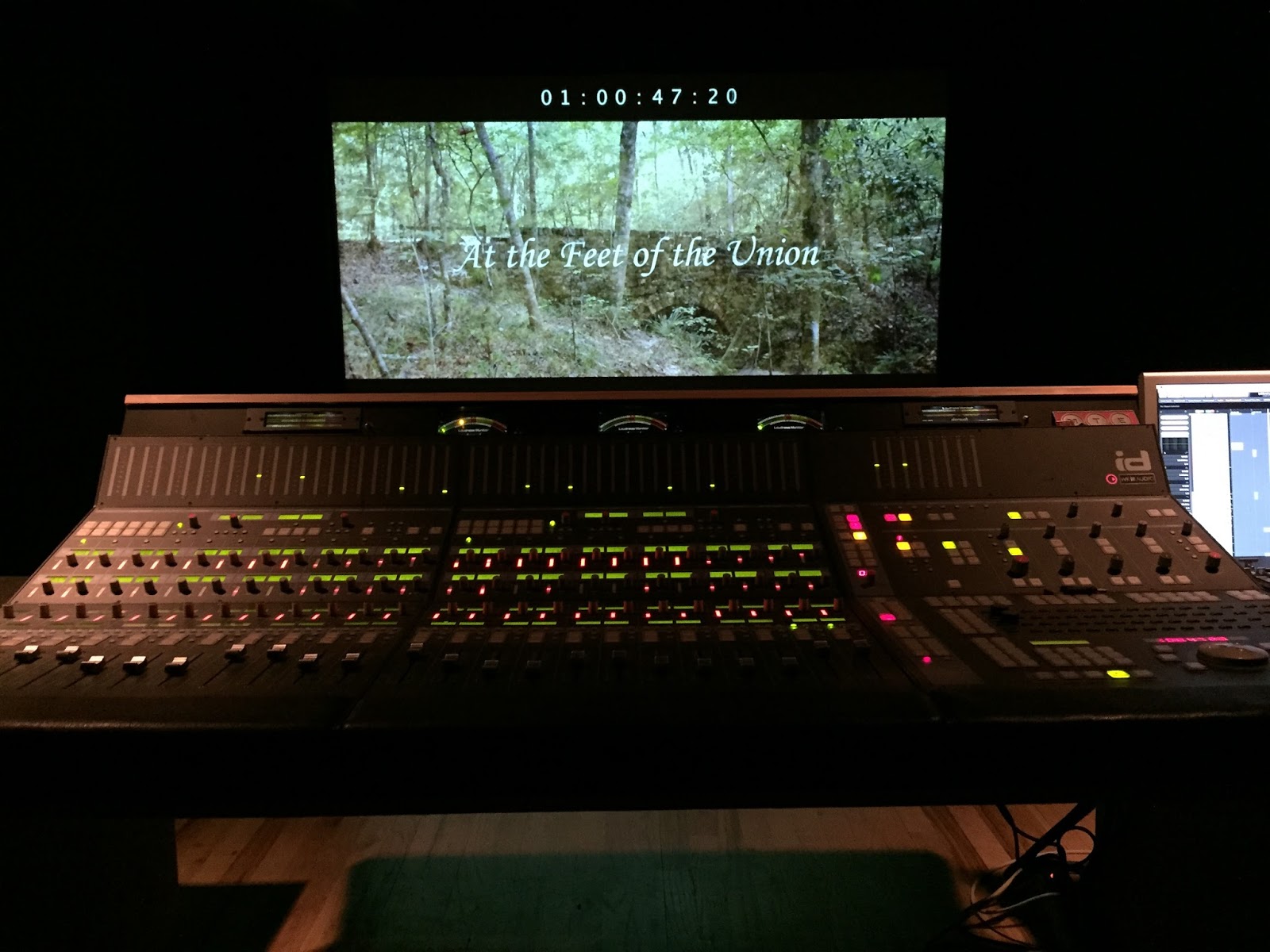
Mixing in the mix stage.
The sound edit was a one week process that started in a calibrated edit bay.  Most of my film was shot during a horrible rainstorm, so almost every single line of dialogue had to be replaced.  I recorded ADR several months ago in an isolation booth, so I already had a good head start on the dialogue edit: I didn't need to do much cutting and filling of white noise at all, which saved me a lot of time.  The school has a great sound library, which is where I pulled all of my backgrounds from.  For foley, I grabbed my friend Travis and spent a day in the school's foley booth.  The foley booth is a lot of fun.  There are multiple surfaces to walk on to create various footstep sounds and dozens of strange props and materials in there to make sounds.  We did all of the footsteps, clothes rustling, prop noises,  and body sounds in foley.  Finally there were a few hard effects I needed to add in, such as guns firing, and I grabbed those from the library again.  After the edit came the mix.  The mix was supervised by Chuck Allen, the post production supervisor at FSU.  Chuck has a career of experience in the music industry behind him and really facilitated the mixing process.  Sound editing is a creative process that is a lot of fun and has more to do with story than anything.  In my opinion, once you learn the basic tools your skill as a sound editor wholly depends on your creativity as a story teller and your understanding of soundscapes and how they can enhance a story.  Sound mixing on the other hand is a highly specialized and technical skill set.  Chuck took my edit and ran it through various auxiliary sends and returns and helped guide me through a strong mix in one of our mix stages at school.  He gave me creative control as far as volume levels and equalizers are concerned, but there is no way I could have done what he did to my film without him.  (We finished the film in a Dolby LTRT format, which I had never even heard of before.)  This experience really showed me the value in getting professionals to work on your film in the finishing department.


My DP, Victoria, working the control surface in Resolve.
Then we moved into color correction and grading.  This is one of my favorite parts of the post production cycle.  I just find it to be really fun and I have invested a lot of time into learning multiple color grading softwares.  This was the first time I got to grade a film in the full version of Da Vinci Resolve.  Previously I have only ever worked in the Lite version, but the full release gave us access to some very powerful noise reduction tools, which helped us out A LOT because at the time of shooting our F3s none of us had had any experience with the equipment package the school provided us.  I had a chemistry teacher in high school who would constantly tell us he believed the best way of learning was through exposure, and that is definitely the school's approach when it comes to gear.  They threw a Red Epic our way with some old 16mm lenses and basically said "have at it."  Each show we continued to learn more and more about the camera and the lighting gear we were using, but the noise reduction was a great tool to help us fix our mistakes.  For example, when it started pouring rain outside during our night exteriors, we lost the ability to light the scene because of the danger of water and electricity, so we pulled up a jeep and used its headlights in tandem with a practical fire on set.  We decided to go with a zoom lens so that we wouldn't have to change lenses in the rain.  A big problem with this was that we couldn't open up the T stop below a 3.5 or something like that, so we ended up with dark and noisy footage.  But if I had to go back and do it again I would make the same decision.  I believe that my DP and I made the best decision we could given the circumstances of the shoot, and the noise reduction really cleaned those night exteriors up.  It was great.  There's an odd little texture that comes from the NR sometimes, but it is WAY more tolerable and WAY less distracting than the noise, so it's just a tradeoff we had to make.

Technical processes aside, I want to talk about what working on a seven minute film for 380-some-odd days did to me creatively.  The production itself wasn't really 380 days: we took a huge break in the middle of that time to continue or regular classes, but that said the F3 was still very much on my mind during that time.  During the year of classes I took during the post cycle of my F3, I feel like I became a completely different filmmaker.  We had some really strong directing classes with Jason Maurer, co-director of the feature length animated film Delgo, and Antonio Mendez Esparza, writer/director of the award winning Spanish feature film Aqui y Alla (Here and There).  I also began an independent study with Jason (which I am still working on) during which we break down scenes from films and work on pre-visualization techniques.  Beyond that, I have really gotten to know our parallel class of students in the Production BFA program and have worked on several of their thesis films.  I feel that this year I had a lightbulb moment, where suddenly some things started to click.  The visual grammar of film, as Martin Scorcese calls it, is really starting to make sense to me and because of a particularly laborious film seminar I went through this year I believe I have much firmer grasp on the core principles of storytelling as a screenwriter.  So the bright side is that I feel like I am a better filmmaker than ever.  The downside is that these discoveries I have made and the things I have learned all taint the way I look at my F3, and when go back to work on sound or color or visual effects or whatever, I just can't stop looking at what I consider to be my mistakes.  Having to constantly go back and analyze and critique my seven minute film for an entire year was a surprisingly difficult experience.  It really made me question my own talent and abilities and really resulted in a lot of soul searching.  It's really hard to adopt a constructive mentality when you know that you won't be shooting your next short film for months and months to come.  In short, I never want to go through a process where I spend so long on something so short ever again.  It's destructive to morale, and doesn't create any opportunities to keep practicing and improving.  I hate to say it, but I don't like watching this film anymore.  I'm not exaggerating when I say that I believe I have watched it over 500 times.  Mistakes should encourage you to be better in your next endeavor, but in this case that encouragement disappeared quickly because there was no end in sight, and the mistakes became like weights looming over my head for a year.  That said, now we are DONE and I am more confident than ever in my ability to make a great new short film moving forward into thesis.  I'm an optimist, and even though the whole F3 process was arduous, I hands down believe that I learned way more from that process than if everything had gone smoothly and I was happy with my end product.  Not only have I learned to become a better filmmaker in terms of blocking, shot selection, cinematography, etc, but more importantly I have learned how to handle high stress situations, how to deal with malicious criticisms, how to adequately self-critique myself, and how to persevere and dig myself out of a creative rut.

Now... on to thesis!

Tuesday, April 7, 2015

Render Me This, Batman PART 2!

F3 Visual Effects at FSU - Week 6


I love my title pun, "Render Me This, Batman," but I quickly became upset that I used it last week because this week the title is SOOO much more fitting.  So, I just decided to use it again and stick a part 2 after it, just like Hollywood nowadays, right?

Last week I spent most of my time lighting and comping for the animated show "Yeti In Paradise, and that inevitably results in rendering.  My renders on that show took a while to complete, but weren't particularly difficult or time consuming to set up, especially considering I was only able to render on two computers.

This week I am working on the animated show "Live Tree Or Die", and our renders are substantially more complicated and taking much longer per frame.  So... I am currently rendering on nine computers.  Nine!

I understand that professionally I will be rendering on render farms that are set up, maintained, and run by a highly specialized and talented IT crew, but for now at FSU we have to manually set up each render - which all things considered really isn't that bad.  The fact we have more than one 32-core machines to render on alone is amazing.  We have a second computer lab at the end of the hall called the DA Suite, and I decided to take it over.  After faculty worked out a spreadsheet for all of the producers to use so that we could allocate computers for each film to render on, this week I was able to come away with nine.  Like I said, each computer's render had to be manually set up as opposed to the more standard system of shipping the scene off to a farm, and to set up the same render on nine machines meant piping the scene through the server and then copying the whole project file to nine separate machines.  Then I had to manually test the the file paths and set up frame ranges on each computer.  All together it took me about two hours running hectically back and forth between two labs to set this up.  What I ended up with was something that would make Lucious Fox proud:


A sea of computers all quietly chugging away in the DA Suite, each using 31 of the 32 available cores to process :,)
Tears of joy.

Now let's hope we didn't miss something in our test renders.....

Tuesday, March 31, 2015

Render Me This, Batman

F3 Visual Effects at FSU - Week 5


This week I moved on to my first animated show of the cycle, "Yeti In Paradise" directed by Lauren Hammond.  I was really excited for the opportunity to work on some animated shows because, while I don't personally have an interest in animating, I definitely can see myself working as an artist on animated films in the future.  I also might like the opportunity of directing one some day should the opportunity arise, but I'm not sure yet.  It's something I definitely need more experience in, which is why I was excited that Lauren was happy to let me jump on her show as a lighting artist.

I've been working hard over the past couple of days on helping Lauren to set up her render pipeline.  She has also helped me learn more about the general animation workflow working with reference files and repeating files when transferring storage volumes.  These are things I was aware of and understood conceptually, but had never actually had to do.  Getting that practical experience was great.

I also have been working on lighting the third shot in Lauren's film, during which her protagonist, Clark the Yeti, walks into a travel agency to buy some tickets only to be rejected and thrown out of the building.  Poor guy :(  We ran into some aesthetic issues with this shot.  We realized after the first day of working on the shot that the space was too flat to achieve the kind of long-shadowed look Lauren wanted.  So we reworked the shot today to achieve a new look that we were both happy with. I think this collaborative experience has been really valuable for both of us and I think we covered a lot of ground on Monday and Tuesday (in regards to rendering) that will end up saving Lauren a lot of time in the long run.  It makes me feel good to know that my contributions will still be helping out the show even after I leave it.

In other news, this morning I worked on cutting together some breakdown reals to present to FSU President John Thrasher, the College of Motion Picture Arts Dean Frank Patterson, and the associate/acting Dean Reb Braddock.  This was a really cool experience for me.  It was awesome to show my work to to them and to represent our college and class.  Seeing how impressed they were were the work our entire class was a huge morale boost for me, and I hope that my classmates feel the same way.  I was particularly happy to see Dean Patterson.  I don't know him well, only having met him a couple of times, but he remembered me well and showed a huge genuine interest in my work even though he's currently on leave.  That is huge to me and means so much.  It's clear that he cares about his students and his school.

This whole cycle has been getting me really hyped to move on to thesis.  I can't wait to continue for all of us to become better artists and to see what we can create.

Tuesday, March 24, 2015

Beam Me Up, Christian

F3 Visual Effects at FSU - Week 4


This has been a really exciting week for me in the visual effects cycle: first, I wrapped all of the visual effects on my F3, "At the Feet of the Union" !!  W00T!!!  Second, I got to move on to Christian's science fiction film, "Flying High", as a matte painter, which I couldn't be more excited about!  Christian is giving me the opportunity to create an entire alien planet for the opening sequence of the film, and he is giving me almost complete creative freedom.

I already posted some of the mountain shots from my F3 a few posts ago, so this post I'll just post some of the ones I haven't posted yet as well as my work so far on "Flying High."


This is a really dark shot, but it is supposed to be.  We didn't have the time or resources to set up a whole Confederate camp, so instead I comped one together.  Classmate Collin Lockett modeled some great tents in Maya for me and textured them using onset texture references taken by AC Grace Colley.  Then I lit the tents, rendered them out, and brought them into Nuke to mix together the tents with several different live action plates.


In a similar fashion to the previous shot, we didn't have the time or resource to recreate a Confederate company.  There were seven of us that could dress in costume, including myself.  We shot 36 plates on set and changed clothes and props between each take, and then it was all stitched together in Nuke and then projected onto rudimentary geometry so that the camera could slowly push in.


This shot wasn't intended to be a visual effects shot, but on set it was raining and the fire burned out.  So I keyed out a healthy fire from another take, tracked it into the moving shot, then recreated the flicker by keying out the real flicker from the healthy take and rotoscoping out problem areas like heads and hands.


This is that matte painting I made for Christian's F3, "Flying High".  The scene involves a stoner named Hunter rescuing his friend Thompson from an ominous alien planet.  Christian tasked me with creating that ominous alien planet.  He gave me a list of descriptive words and 5 pieces of concept art from some of his favorite films that reflected the mood and look he wanted.  So after looking everything over and talking over some basic layout with him, I went to town in Photoshop creating this matte painting.  I started by using some texture brushes to block out the colors and shape of everything I wanted, and then I began texturing some of the planar surfaces using high res texture photos taken from the set.  Then, I began gathering a library of images that would fit the painting from the public domain.  From that point on it was just a matter of warping the images to fit into my blocking, recoloring the photos to look like the belong together, adjusting lighting and value to create depth, and adding it atmospherics.  I was even able to fit in the famous Vasquez rocks!  That was my subtle way of tipping my hat to some of the most influential science fiction moments in the 20th century.  I had a lot of fun bringing in some of the intricate detail into this painting.  My favorite parts are the rivers of blue lava.  I really like what those bring to the shot.

Anyway, that's what I've been up to this week!  Next week I start work on the animated film "Yeti in Paradise" then the animated film "Live Tree or Die" before hopping back over to "Flying High" for the the last two weeks of the process.  It should be an exciting time, I am really looking forward to the changes in scenery!  I have found that staring at the same shots for too long can sometimes be discouraging, and it can definitely become monotonous.  I'm really excited to keep moving forward in this cycle and to see what it brings.

Tuesday, March 17, 2015

Back to Business


F3 Visual Effects at FSU - Week 3

Technically week four, I'm back after a week off for a rocking Spring Break in LA.

For week 3, let's talk about Nuke.


I have been spending almost 8 hours a day in Nuke for three straight weeks now.  My total time spent in Nuke comes out to about 27 or 28 hours a week, which means that since this cycle has started I've spent close to 84 hours or so in the program.  Couple that with the 10 hours or so a week I was spending in the program over the 8 weeks before VFX started for classwork/homework and the experience I brought in from our intro course last semester and it starts to add up to a lot of hours in the program in a relatively short amount of time.  I have really learned a lot about the software and am immensely happy with my progress in it.

This past week I have spent the majority of my time working on crowd replication and 3D camera projection.  These are big steps for me.  The crowd replication shots pushed my knowledge of keying and forced me to start looking for creative solutions.  Here are three things I started doing to my keys that made them stronger keys that looked like they belong:

1.  Edge Correction
One problem I was facing was green tinted edges around the edges of my comp.  Getting rid of them by eroding in sometimes wouldn't cut it.  It took me a while to sort out how to pull this off, but I eventually figured out that I could make a separate pipe off the keylight node, erode in the key to get rid of the edge in the alpha, then invert that alpha so that only the edge was present.  Once I had isolated that edge, I could use it as a mask on a color correct node and get rid of the green by grading it out.

2.  Core Mattes
One problem I was running into was the key pulling data out of the green channel across the entire plate, not just the screen.  This wasn't always an issue; it only became an issue on some of the noisier footage that was shot slightly underexposed.  To solve this problem I had to matte an alpha channel into the plate by using a shuffle node, then feed that shuffle down a separate pipe and merge it back into the main pipe after the key was pulled.  Then I just had to make a rough garbage matte in a roto node, animate it quickly to follow the action, and apply it as a mask to the new merge node.  I don't think this is the best or most accurate way to make a core matte considering it requires me to animate some roto mattes.  However, in this particular shot all of the subjects in my plates were standing almost completely still so this method was extremely fast and the results were great, and I do believe the best methods are the ones that provide the best results the fastest on a shot by shot basis.

3.  Keymixing
The ability to quickly and easily key mix in Nuke is one thing that makes Nuke a superior keying solution to After Effects.  In After Effects, it is possible to "keymix," but it requires either duplicating your plate as many times as your keymix will require and then masking and keying each plate separately or precomposing your composition after each key.  Both equally obnoxious and frustrating.  In Nuke, it's as simple as pulling another key and then plugging both keys into the keymix node and applying a fast garbage matte roto mask.  It's very fast and is just as easy to mix in the twelfth key as it is the second, as opposed to After Effects which gets harder and harder with each mixed key.  Keymixing was a fast and efficient way for me to isolate color variations across the green screen and take care of them.

In addition to these three keying techniques I used to help sell my crowd replication shot, I also added  in a 3D camera move in an effort to help glue the shot together and draw focus to the center of the frame.  In order to pull this off I had to utilize the technique of 3D projection mapping.  In After Effects I have created 3D moves by separating assets onto planes and pushing them back in z space dozens of times, but I had never attempted projection mapping before.  In AE, projection mapping is an overly convoluted and difficult process that I rarely had a need to even attempt, and when it could have come in handy I just chose to look for an alternative solution.  In hindsight, I really should have put the time into learning how to projection map in AE, but in Nuke it was an amazingly logical and fairly straightforward process.  I roughly modeled the scene out in 3D space using planes that I oriented to match the space (ground plane, house, people, etc) and then projected my comp onto the 3D scene using the Project3D node in Nuke.  The more accurate your 3d geometry, the more correctly the projection fits and the more accurate your camera move becomes.  But this scene was so simple just using rough planar geometry was enough to get by.  Again, the fastest way to achieve the result is the best.

I have learned a lot about Nuke over the past few weeks by being forced to think through all of these issues and come up with creative solutions.  I am really excited to see where I go from here with Nuke, and if I continue to learn and progress at this current rate I truly believe that by the time thesis visual effects roll around I will be at the level of total photo real compositing.  I just have to work on my 3D rendering first :)

Tuesday, March 3, 2015

Time to Go Mobile - Putting the Pedal to Floor to Deliver Market Fresh VFX in 8 Minutes

F3 Visual Effects at FSU - Week 2


We're now over a week into visual effects production on our third student films at FSU and progress is really cranking.  I've only been working on my own film so far, and that has created an interesting feeling and approach to the work I have been doing.  I wrote last week about the schedule that I am trying hard to stick steadfast to, and now that I've experienced a full rotation of that schedule one side effect I hadn't really intended is that it almost industrializes the experience of creating art.  As opposed to writing or directing, with visual effects I really can just come in to school, put in an eight hour shift, and go home.  Writing, directing, and other steps towards the front end of the pipeline seem to occur more organically to me.  Ideas form slowly, taking shape over time with excitement and coming together to culminate in the amazing experience that is the creative process.  This is where working as the primary artist on my own show in this workplace of an environment starts to create the interesting feeling I mentioned above: because this film is MY idea and MY passion, I want to scrutinize every pixel of every frame and spend an eternity on each shot making it absolute perfection, even if that level of perfection is beyond my current skill set.  It is very hard for me to move on to a new shot whenever I "finish" one, because to be honest I'm not satisfied with any of my shots.

Let's flip the tables to when I'm not working on my own show anymore.  Presumably, I will be working towards another artists vision, obviously putting my creative fingerprints on their work but still reaching towards something that inherently isn't mine.  Suddenly, I might not be a huge fan of a part of my work (for aesthetic reasons) but it fits the directors vision and he or she loves it.  When this state is achieved, I feel like it will be much easier to move confidently from shot to shot knowing that I have completed my task and satisfied the director.  I believe that reaching a level of personal satisfaction will be easier if I am meeting the expectations that others place on me, because I won't have the burden of creating my own "perfect aesthetic."

This isn't to say I won't put forth 100% effort into other peoples' shows - on the contrary I plan on giving every show I work on everything I have to give.  I just theorize that it will be easier to be emotionally satisfied with my work when I'm working towards reaching someone else's design, because I always find flaws in my own work.  Ultimately I'll just have to wait and see if this reins true.  So far in my "career" as an artist I have only worked as a visual effects artist on two films that weren't my own, and I was only on each film for one week.  But it seemed true during those two weeks, so we'll just have to see if it stays true for the five weeks I work on other shows during this VFX cycle.

I keep telling myself that never being satisfied with my own work is probably a good thing, pushing me to work harder and get better, but ultimately it becomes a discouraging emotion and that's what I'm pushing through right now - finding the strength to stay on schedule by leaving one shot behind and moving on to the next.  Speed and structure are important, and without this kind of schedule it might become really easy for shots to get pushed back and pushed back and for things to missed and for deadlines to never be met until eventually the film never gets finished.  

Additionally, Ive found that this week has been a little difficult in the lab for personal reasons.  Artists will quarrel with other artists and sometimes feelings get hurt on both ends of the spectrum.  I believe it's crucially important for me to take those kinds of experience personally, examine them, grow from, become a better artist from them, and work through them, continuing to create quality work in a professional environment.  I can't let disputes bring me down, I have to harness what they can give me and find ways to improve from what they bring.

To sum up, I've come out of this week feeling a little discouraged with my own work, but I'm trying to use that experience to propel me to make better work than ever.  I'm also working at a pace that is completely new to me.  In fact, it is this speed that inspired the title for this weeks post.  It came from a fantastic YouTube video I discovered a couple of years ago after The Dark Knight Rises came out.  You can watch it here if you have the chance.  I encourage it, I found it quite enjoyable.

I'll finish the post by showing some of the shots (at various levels of completion and also highly compressed) I have been working on thus far.  I shot in Florida, but am striving to make the show feel like Tennessee.  Hope you enjoy!

Thomas and General MacArthur overlook the Smoky Mountains in Tennessee at Sunset.

The same shot from a slightly different angle.

Close up on Thomas at Sunset, the Smoky Mountains a haze in the distance.


Tuesday, February 24, 2015

Out of the Frying Pan, Into the Fire - Welcome to the Production Pit

F3 Visual Effects at FSU - Week 1


First off, I'd like to say that this weeks title was completely stolen from my friend Collin, who titled his blog post the same thing.  But then again, the title is originally from Chapter 6 of JRR Tolkien's The Hobbit, so I'm just stealing what Collin stole first.  It's my way of a not-so-silent protest.

This week we started visual effects on out F3s, our third student films at FSU.  For the zero people out there that actually keep up with my blog and are wondering about what happened to the F2, maybe someday I did briefly gloss over it it posts here and here.  I probably won't ever go into a detailed BTS of it like I did with the F1, but going behind the scenes of the F1 was more of a reflective exercise for me in my spare time and I've kind of changed how I do that now.  Now I keep a small journal and sometimes I'll go outside and noodle some thoughts in it or something.  Our workload at school has also changed dramatically: new city, new professors, new curriculum - essentially a new life.  I think it's important to change how you do things as your world around you is changing.  I had an English teacher in eighth grade who made sure he made at least one big change in his life every couple of years.  For example, one day he decided to start brushing his teeth left handed and he's been doing it ever since.  Likewise, a couple years later he decided to start tying his shoes backwards.  Never went back.  I've never tried doing something like that on the minor scale that he did, but I think that the concept would apply in the macro to our lives as a whole.  But what the heck do I know, right?

For the F3 visual effects cycle, the faculty are giving us eight weeks.  I got scheduled as an artist on four films, including my own.  So this comes out to roughly two weeks per film, but that's not how I got scheduled.  I'm spending three weeks each on two live actions films as a matte painter and compositor and one week each on two animated films as a lighting artist.  I couldn't be more excited.

For the entirety of film school so far everything I have done has been on a Mac, but for this cycle we were moved to a lab colloquially called "The Production Pit" - all PC's.  The adjustment has taken a little time to get used to - mainly I keep hitting alt instead of control because that's where the command key is on a Mac - but the machines are much faster and more powerful and I haven't run into any issues.  We also have dual 35" monitors and HUGE tablets.  Sometimes I have to pinch myself.

We've only been in the VFX process now for two days but already I have been incredibly productive and am super excited about my results.  This year I am tackling all my composite shots in Nuke instead of After Effects, and while I will always love After Effects - and still firmly believe it is a better program for 2D motion content creation - Nuke is an absolute dream.  I am able to achieve better results faster, and that's something that just doesn't happen every day.  So far I have completed one matte painting asset and almost completed one shot composition, and I believe that they are on the photo-real level which makes me unbelievably satisfied.  I have been working towards the goal of photo-real set extension for years now and this shot might be the first time I have ever accomplished that.  Years of practice from middle school up is really starting to pay off... at least I think it is.

One reason I believe I have been able to complete a matte painting asset and photo-real composite in just two days is because of an incredibly efficient time management workflow really stressed on me by my professors Jason and Ken.  They have pushed taking a 5-10 minute break every couple of hours, not working over time, timing yourself while you work, and meticulously logging all of my hours.  Additionally, my professor Jonathan helped all of our shows set up incredibly detailed shot breakdowns using a management solution called Shotgun.  This workflow has kept me laser focused in the lab.  I built a playlist in the glorious Spotify of some of my favorite music and some new music, made an account at www.toggl.com to start timing myself while I work, put my headphones on and have been powering through tons of work at a high speed and still had time to relax and play basketball in the afternoons.  This new schedule really excites me because if this pace continues, not only will I be getting more work done but I will also have more time to myself to get back in physical and spiritual shape.  In the F2 VFX cycle, I worked close to 16 hours a day for two weeks straight, and by the end I looked horrible, felt horrible, ate horribly, and each day dragged on and I got less and less work done.  If I really can get much more work done in this much more reasonable F3 schedule, I will have discovered possibly the greatest thing in the history of mankind...

I'm really looking forward to continuing through the visual effects cycle and becoming a better artist, while having more time to myself to develop thesis and other short film ideas.  I've also freed up a lot more time to play basketball, which is great especially considering I'm out of shape right now and my intramural team needs me more than ever as we move into the playoffs.  Tonight we played our first playoff game and won by 1 point with 2 seconds left.  It was awesome.  Hopefully and can keep winning and extend our season by another five weeks - that championship t-shirt really would look great hanging up in my closet.

Saturday, May 17, 2014

Star Wars: Episode VII and My Upcoming Second Student Film

It's high time I write another post, and I was torn between discussing my excitement for the next installment in the Star Wars saga or writing about my [now completed] second student film.  So... I decided to kill two birds with one stone and write about them both!  I don't really plan theses posts out, so maybe by the end I'll have found some way to tie the two together to give some form of coherency to this post... but probably not.  Let's start with my second student film, "Red Soil."

My second semester of film school was significantly different than the first.  For the vast majority of the first semester, I was ahead of the technical learning curve.  I already had a good deal of experience in cameras, video editing software's, Photoshop, and After Effects.  On the technical spectrum over the course of the first semester, the thing I learned the most about was audio mixing.  I challenged myself to really learn Audition and switch to it as my primary audio editor for both film and music (which I had previously been using Garageband for).  All this was on my own though, although I have to pay it to the school for giving me access to all the softwares and a vast collection of resources to learn from.  However, on the creative end of the first semester, I found all the coursework was geared towards breaking down my current ideas and stances on filmmakers.  I came in with a lot of preconceived notions, and the creative coursework for Semester 1 seemed to really be all about erasing them.  The second semester marked the start of building them back up, while simultaneously presenting new technical challenges for me to grasp in the world of 3D.  The second semester's creative coursework was all about interpreting scripts, directing actors, and really seizing your vision and directing a team to actualize it.  There was very little story training in the second semester, as opposed to the first where we took an entire class on storytelling.  As the creative focus of the second student film was interpretation and directing actors, we were not permitted to write our own script and were instead given a script to interpret.  A pool of about 30 scripts was released and we got to choose the one we wanted to film.  I chose a script called "Red Soil", and I'll get to why in a minute.  As mentioned earlier, the technical focus of the second film was on 3D visual effects, and we began work on 3D modeling, texturing, and rendering in Autodesk Maya.  One of the prerequisites of the second film was that it had to include visual effects.  I chose the script "Red Soil" because it took place on Mars, and out of all the scripts that were presented to us, I thought it would face me with the biggest challenge in terms of visual effects, and the opportunity to learn more about VFX than any other script could.  The script was written by classmate Lauren Hammond, and is about a young girl on Mars who is faced with a critical decision after her brother discovers that the planet's teraformed ecosystem is failing.  The film is now complete, and I can't wait to post it online for people to see!  This summer I will also be creating a VFX breakdown of some of the shots from the film, that I will no doubt be blogging about later.  As for the behind the scenes of "Red Soil", I will definitely be writing a BTS post before too long, but I will probably limit it to just one as opposed to the three I wrote about "Starfishing."  The F2 films were all limited to two and a half minutes, due to the extensive amount of post production work that goes along with VFX (one student passed 1000 hours of render time...), so there won't be that much to talk about.  Furthermore, I view this second student film much less as a personal creative piece of art and much more as a learning experience.  It's not a story I would have written myself, but I challenged myself to pick it up anyway and make it my own while also challenging myself to create the most difficult visual effects I have ever attempted.  I learned sooo much over the process, and I think that with the conclusion of the F2 and the second semester, my preconceived notions had been successfully torn down and the foundation for the rest of my education has been laid.  I can't wait to get into the F3 and use this new knowledge and outlook on filmmaking to a new original story.

One thing several classmates commented about my choice of script was the fact that it was a science fiction, like my F1.  I at first defended myself, saying that I chose "Red Soil" not because it was science fiction, but because it presented me with awesome learning opportunities.  While I still believe that to be true, I can't help but acknowledge a grain of truth to what my classmates were saying... what can I say, I'm a Sci Fi buff!  (Here comes that connection I talked about!)  Star Wars was what inspired me to become a filmmaker, and all (literally ALL) of my first home movies were Star Wars movies.  JJ Abrams had solidified himself as my favorite contemporary director with the release of Star Trek II: Into Darkness, and then when they announced he would be directing Star Wars VII I literally flipped.  I have never been so excited for a film in my entire life, and honestly I have complete confidence in the filmmaking crew that is making Episode VII, especially since they are reportedly following George's original story outlines for Episode VII.  I believe that while George Lucas might not be the worlds best screenwriter, often times poor with dialogue, overkilling comic relief, and struggling with pacing, he is a FANTASTIC story teller who has constructing the amazing story that is Star Wars.  Hiring great writers like JJ Abrams (Super 8, Armageddon) and Lawrence Kasdan (Empire Strikes Back) to write Lucas' story for Episode VII fixes that problem and presents us with - hopefully - the best screenplay possible.  I also love JJ's visual style - yes, I'm a fan of the lens flares - and know that the film will look amazing.  JJ is a character driven director, which is exactly what the saga needs after a story-centered prequel that received the amount of criticism and disdain that it did.  When it comes to plot and storyline, JJ prefers to emphasize the mystery.  He gave a fantastic Ted Talk on what he calls the Mystery Box, this idea that so long as you keep the box shut, no matter what is inside the audience will keep watching.  I think this is most apparent in Lost.  I think the combination of a character centered film with a brand new Star Wars mystery for audiences to be intrigued by, following the treatment of one of the greatest storyteller's of our generation along with the return of the beloved original cast will make for a fantastic film.  I'm confident this film will be awesome, and I just can't wait for it.  I had to write a post about it in some way shape or form, because going back to Star Wars is going back to my roots.  It's why I'm here in the first place, and while I am my own filmmaker with my own ideas and my own stories to tell, Star Wars will always hold a special place in my heart (along with Lord of the Rings) and will always be an influence to me in everything I make... and who knows, with three new Star Wars films (plus spin offs) on the horizon, and my upcoming graduation form film school (2016), I might even find a spot on one of them... At least I hope so :)

This particular post almost seemed barfed out my brain, with one paragraph teasing at upcoming posts and the other fanboying over Star Wars, proving my true nerd-dome to the galaxy.  But hey, it's something to keep the blog going while I wait for the distribution process of "Red Soil" to complete (Hopefully May 28).  If you have any thoughts about Episode VII or Star Wars in general, post them in the comments (although I don't expect anyone to), because who doesn't like a good discussion about Star Wars!?

Monday, April 14, 2014

What "Starfishing" Means to Me and Various Happenings In My Life

In my Behind the Scenes posts for "Starfishing", I mentioned that I wanted to write a fourth part that involved the more personal elements of what my film meant to me and what I hoped it would mean to others.  I've decided to take a different approach to discussing those things based on some things that have happened to me lately, so this is really as close to a Behind the Scenes of "Starfishing" Part 4 that I'm going to get.

I'll start with a question.

Have you ever been scammed?

It's a horrible feeling, and one I experienced for the first time this week.  It was about 9:50pm and I was rushing to get to Publix before it closed so I could buy some groceries for the week.  I had spent a little bit too much money as of late so I knew I needed to get some cheap groceries that could last me the week.  I made it in time and got about $20 worth of food, feeling good about myself.  On the way out the door a man stopped me and asked for $3 for a bus ticket.  He explained to me that his car was broken down and he had to meet his daughter somewhere.  I would have loved to help him out for the small price of $3, but I was out of cash.  I told him I was sorry, and started to walk away but he continued to ask if there was anything that I could do.  He said he was running out of time and that no one would help him.  I really wished I could have helped him, because he seemed genuinely worried and he was only asking for $3.  At this point he pulled out a Publix gift card and asked me if I would buy it off of him.  I told him again that I had no money, so he offered to go into Publix with me to try to cash it out.  But Publix was closed, and the door was being guarded by a police officer, so we couldn't go it.  Finally he remembered that there was an ATM down the street and begged me to please buy the gift card from him.  Finally I agreed and walked with him to the ATM and withdrew $20.  On the way I got to know him a little better.  He was from Louisiana but went to school in Illinois and got a major in political science.  He was 64 years old and a middle school teacher at a local middle school.  In the 70s he played two years of pro football with the Minnesota Vikings.  He also told me he was a Christian and that he believed God was always looking out for him.  Finally I bought the gift card from him and we parted ways.  As I examined the card, I noticed some funny things.  It appeared it had already been peeled off the cardboard cover.  The $25.00 was sloppily written on the card in smeared ink.  And then it occurred to me: this is a used card and I just paid a man who told me his sob story $20 for it.  The more I thought about it the more it made sense.  He was hanging around Publix at the time he knew it closed, and told me that the card was legitimate and that I could go in and check the balance knowing that Publix was closed, but pretended not to know.  He didn't follow me to the door where the police officer was standing.  He made sure to stress that he was a good Christian man and he knew exactly where the ATM was and what the fee was (he made sure to mention it was only a $3 fee).  He also told a detailed story about his life in effort to gain my trust.  As I walked back to my car, I realized that I had been had.  It was a frustrating realization, and also a sad one.  It makes me sad to know that there are dishonest people out there who will take advantage of the people who actually are willing to help.  I called my parents and explained to them why my account would be $23 emptier then went home and called it a night.

The next day I went back to Publix and decided to check the balance of the card just incase.  I knew it was going to be in vain, but in my heart I kept this small since of hope that maybe this guy was an honest man.  I handed the card to the cashier and waited for the balance.  Finally the receipt printed.  Balance: $25.00.  I was shocked.  I wasn't scammed!  It was such a good feeling to know that not only was I not scammed but that I was able to help someone out that was in need.  Fiscally, the world seems to scream that having a good conscious can be a naive thing, and I was afraid I had learned that the hard way.  But in the end my act of kindness had paid off.  But that emotion got me thinking: what if I had been scammed?  Perhaps I simply lucked out this time and really was being naive...

But the more I think about it, the more I come to the conclusion that if I had to go through that experience again I would do exactly the same thing.  There are only two possible outcomes: I help the man out and keep my money, or I help the man out and lose my money.  But there is only one possible cause: that this man needed help.  Either he was in a tight situation or desperate enough to result to scamming people in the streets of West Palm Beach.  Either way, I was in a position to help this man who needed help whether he was humble enough to admit it or not, and so I sit confidently knowing that even if I had been scammed I did the right thing.  (Now this is not to say that everyone is in the position to help and should just fork over $20.  For some people that $20 could be the difference in keeping the lights on or feeding a family, and if you are not in a position to help then I believe you should kindly move on, but I was not in that tight of a situation.)

And that brings me to the other morning.  I decided to meet a friend at taco bell breakfast (PS it's really good if you haven't tried it yet) before heading into the computer lab to work some more on the visual effects of my upcoming film.  As I was leaving taco bell, a homeless man rode up on a bicycle and started a long speech about the labor pool etc etc.  Essentially he needed food, and unfortunately today homeless people have come to realize that without an explanation, most people won't pitch in to help them get the food they need.  I didn't care for the story, I told him I would go in and buy him a meal, so I did.  In this specific instance, the words of my old youth minister echoed through my head: "If a homeless man turns down a free meal from taco bell he's either not homeless or something's wrong with him."  Food is a human necessity that everyone needs, and I believe buying someone a meal is a great way to show them that there are people out there that care about them... ESPECIALLY if it's Taco Bell, I mean, come on.

As a Christian, I believe that the Gospel message is abundantly clear when it comes to helping other people and showing them God's love.  Jesus' story is full of examples where he helped people who, by all Jewish standards, shouldn't have been helped at all.  In fact, most of the great stories in the Gospels involve Jesus helping sinners who were unworthy of the Jew's time, or let alone of God's grace. But the fact is we are all unworthy of God's grace, yet He gives it to us anyway.

That is the Gospel message, and that is a message that I want all of my films to support.

I've heard the expression before, "If you give a man a fish, he can eat for a day.  But if you teach a man to fish, he can eat for the rest of his life."  This is a concept I completely agree with, and I hope that someday I will be in a position to support charities and organizations that "teach men to fish."  However, I believe this expression is often misinterpreted to "Don't give a man a fish, teach him to fish instead."  But I don't think this can be more wrong.  Sometimes, giving someone that fish can be the first step in teaching them to fish, and you never know when that fish you give them - whether it's $20 for a bus fare or a steak burrito from taco bell - could change their life forever, or even save it.

I believe that when you are in a position to help someone, there really are no negative side effects to helping them.  "Starfishing" was a small film during which I tried to explore the value of selflessness and helping others, but hopefully someday I will be able to make films that explore the values of love, mercy, grace, redemption, and sacrifice in a way that is intriguing, convicting, challenging, and exciting for everyone, not just Christians.  I want to make films with themes that people of all different world views will be proud to stand by and support, yet not lose the heart of the Gospel message.  To me, "Starfishing" is about much more than helping others because it embodies my dreams and aspirations as a filmmaker.  I hope that everyone can gather something unique from the film, but that through it all the central message of loving others and helping those in need shines through.

Monday, February 24, 2014

My First Student Film! - "Starfishing"

I've been trying to get around to this post for a couple of months now, and finally here it is!  All those weekend projects I posted and all the classes I went through during my first semester all lead up to this production.

Each person in my class wrote and directed their own student film.  We began the writing process in our story class a few weeks into the semester.  As the semester went on, each class began to devote more time an effort into our first student films (called F1's - see the Film School Lingo post).  After writing the script, we had to break it down both from a creative standpoint and a production standpoint.  Creatively, we looked for beat changes and various strategies that the characters used to reach each beat objective.  This in turn affected how we directed our actors during rehearsal and on set.  From a production standpoint, we broke down the script looking for what locations, characters, props, and other expenses would be needed.  Eventually we held a casting call and I cast two wonderful actors: Ryan McInerney and Nikki Smith.  Both of them did an excellent job both in rehearsal and on set and were awesome to work with.  Finally our regularly scheduled courses ended in week 11 of the semester, and we went into production on Monday of week 12.  Each student had one 12 hour shooting day to complete their film, and we entered post production on week 13.  We had the next three and a half weeks to edit our films until viola, we reached our finished products!

I will write more about the film later - I hope to have a couple more posts where I go more in depth into the film, the production cycle, and what my film means to me.  But that being said, please check out my first student film!  Please share it and show it to your family and friends, it would really mean a lot to me.  For my small audience out there, thanks so much for the support.  It really does mean a lot :)